What's wrong with the math behind triple leveraged ETFs?

Leveraged ETFs are a popular tool among traders. They can deliver outsized gains over short periods and, if we’re being honest, their exaggerated volatility can provide a thrill for some users. However, they come with some serious caveats when held over longer periods.
Below we will explain how these funds can be harmful, even if the underlying index is trending in your favor.
High fees – Leveraged ETFs typically have rather large management fees embedded in them. This is not necessarily a case of the fund managers being greedy. The nature of these funds is that they are expensive to maintain.
Leveraged losses – The lure of these funds is the possibility to get double or even triple the gains of the underlying asset. Sometimes people are a bit too confident in their trading and forget that there is also a real chance of bigger losses quickly, as well.
Daily reset – The 2X or 3X leverage does not begin with YOUR purchase of the fund. It is recalibrated every day to maintain the proper amount of leverage in the fund. This is where most of the trouble begins.
The surprising math behind the daily reset
It is not obvious to most people, but the need to produce daily returns that are a multiple of the underlying asset or index is a constant drain on the fund’s performance. What you see below might be an eye-opener.
In this first example we will imagine a mystery asset priced at $100 and a triple leveraged ETF based on that asset, also with a starting price of $100. On Day 1, the asset goes up in price to $101. The next day back to $100. Then back to up $101 again. And on Day 4 returns to $100. Let's see what happens to the leveraged ETF.
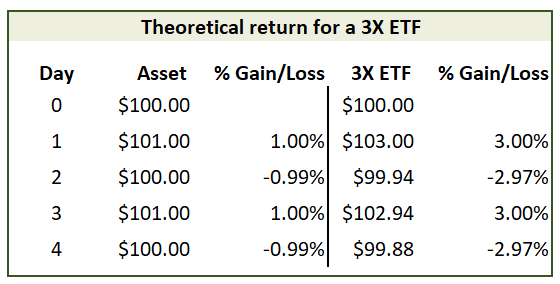
Our mystery asset started and finished at $100. Did you expect the leveraged ETF to also finish at $100? The reason for the difference is that the ETF is concerned about the daily percentage gains and losses, not the dollar amounts.
And the more volatile the asset or index, the more the leveraged ETF bleeds.
Next, we’ll do something a little more sophisticated and simulate an index and its triple leveraged counterpart for 100 days with the following parameters:
- Both the index and the ETF will once again begin at $100
- The daily return for the index will be drawn from a normal distribution with a mean of 0.05% and a standard deviation of 1%.
- The ETF will track the daily returns by a factor of 3X
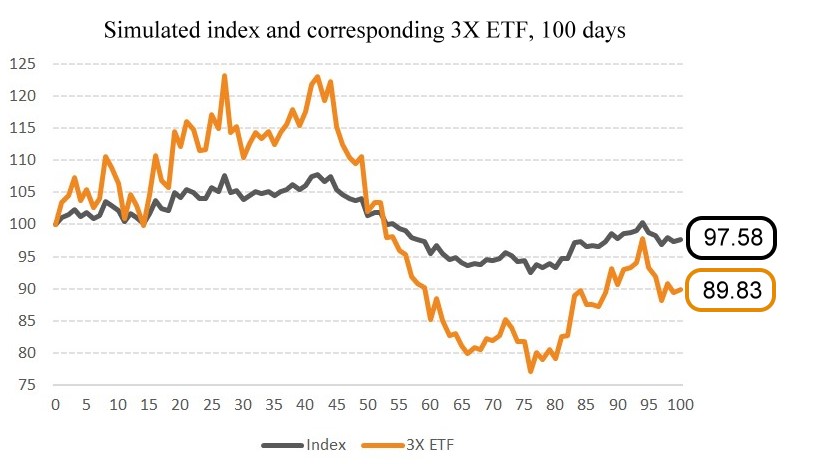
Our imaginary index lost 2.42% by the end of 100 days. You can be forgiven, but only a little, to expect the triple leveraged ETF to lose 3X that amount, or 7.26%. In fact, it is down 10.17%!
The steady drip caused by the daily reset has added up to nearly 3% in additional losses in this example.
Finally, let's look at a real example in the wild.
Below you see the S&P 500 (SPX, red line) and its triple leveraged cousin (SPXL, blue line) for the first half of 2025. During this time, the S&P 500 went up 5.50% according to Stockcharts.com while the leveraged ETF gained only 3.57%.
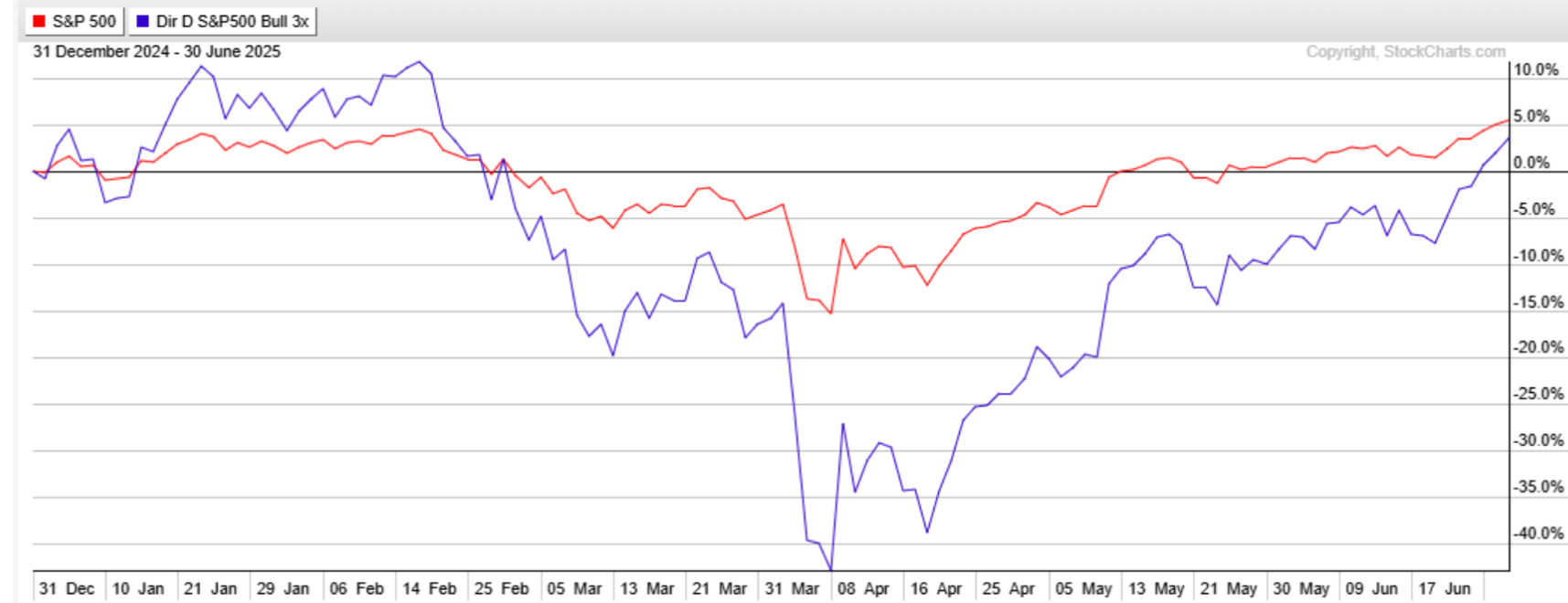
Wait a minute! Isn't the leveraged ETF supposed to magnify the returns? How did SPXL actually do worse than the index even though the index is up?
By now, you should understand the reason. The inconvenient math behind the daily reset melted away all of the benefits of the leverage and, in this example, even took a little more.
Sign up for The Prime Wave, a free newsletter for swing traders from swingex.com.