Swing Trading With Low Volatility Stocks

Swing trading is most often associated with stocks that relatively more volatile. We’re talking Tesla, NVIDIA, Coinbase. Is it possible to swing trade “boring” stocks?
The answer is yes, but it is a qualified yes.
It can be done, and it is done, but you have to think about it differently. The tactics that you used to successfully trade Palantir probably are not going to work on Coca-Cola.
At Swingex, we tend to think of swing trades as lasting from 3 days to 3 weeks. When you are dealing with a stock with lower volatility you should generally aim for the longer end of that time period. You need to give the trade enough time to produce a meaningful gain.
Some say that a good background in technical analysis is necessary to trade low volatility stocks because those stocks tend to “obey the rules” of technical analysis more than others. We are not so sure that this is true. To us, it is more a matter of the cost of failing to obey the rules being much higher with more volatile stocks.
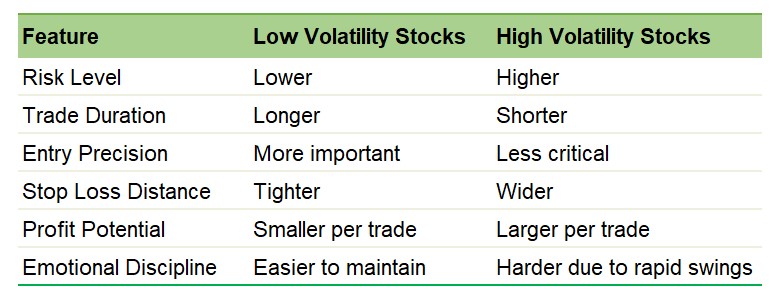
One way traders can goose their performance is through leverage. This is true regardless of the amount of volatility involved, of course. The difference is that leverage with lower volatility stocks will not irritate your portfolio as much. A combination of higher predictability and higher leverage can beat trading the latest hot money stocks.
Traders who handle low volatility stocks are more likely to pay attention to sector rotation to help time entries and exits. The type of stocks we are talking about tend to be concentrated in a few sectors of the market. Consumer staples and Utilities are traditional places to look. If you can catch those sectors when the market turns in their favor you will be ahead of the game. If you are not already, get familiar with Relative Rotation Graphs.
Where can you find potentially tradable low volatility stocks? Our favorite go-to source is the Invesco S&P 500 Low Volatility ETF (ticker symbol: SPLV). It holds the 100 stocks in the S&P 500 with the lowest volatility. The fact that they are included in the S&P 500 means the list comes partly filtered. You already know that these stocks meet the conditions to be in the index, such as market cap and trading volume. You can easily use this as a shopping list.
Sign up for The Prime Wave, a free newsletter for swing traders from swingex.com.