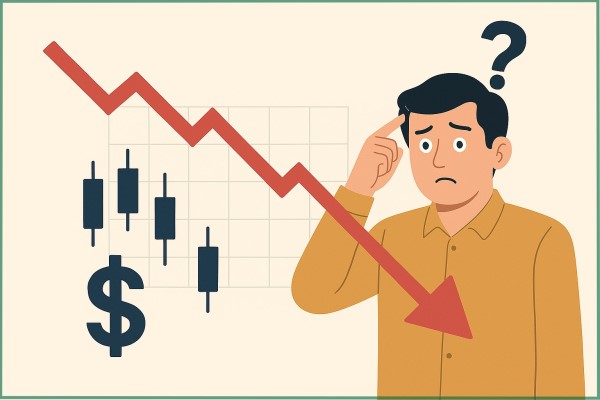
10 Reasons Why Your Stock Went Down After Good Earnings
People are often flummoxed, sometimes even angry, when their favorite stock beats earnings expectations and then gets beaten down by the market. There is usually a good reason why this happens. That reason could be obscured or hiding in plain sight.
Below we round up ten of the most frequent causes of this unexpected behavior.
1. Sunny Day, Disappointed Tourists
Earnings can beat expectations on paper, yet fall short of the market’s unspoken hopes (a.k.a. "whisper number"). Expecting to beat expectations may sound nonsensical, but those second-order expectations matter more than the official estimates Wall Street provides.
Lesson: “Great weather isn’t enough when everyone packed for a heatwave.”
2. A Cracked Crystal Ball
Earnings for the previous quarter may have been excellent, but management provided some luke-warm guidance for upcoming quarters or years. It’s the future that people invest in, not what already happened.
Lesson: “Yesterday was sunny — tomorrow looks foggy.”
3. They Made The Pie Higher, But…
The company’s revenue is increasing, and possibly along with it are increasing earnings. But there’s a problem: their profit margin is shrinking. Following from point #2, investors may see that the company’s future trajectory is not what they had in mind.
Lesson: “Higher revenue, shrinking bite.”
4. A Balloon With A Slow Leak
Earnings look great on the surface. But digging into the details, it turns out that profits were inflated by some one-off event(s). These can include things like a gain on the sale of company assets, a paper gain from foreign currency translations, or some accounting magic.
Lesson: “EPS is floating for now, but will come back to earth.”
5. A Rocket That Already Reached Orbit
Your stock may not have rallied after a good earnings report because it already ran up in the days preceding the announcement. Everybody (including you?) bought in advance of the report and now some are going to "sell the news".
Lesson: “When you’re already in space, there’s no room for liftoff.”
6. Gimme Shelter
External macroeconomic forces — interest rates, geopolitics, sector rotations — can overpower even the best company-specific results. If the market is in a “risk off” mood, a good earnings report might not be enough to provide shelter from the storm.
Lesson: “Strong foundation, terrible weather.”
7. Smiling Charts, Nervous CEO
The reported numbers are solid, but a cautious tone on the earnings call by the company’s representatives can derail a possible pop in the share price. They may have left their official forecasts untouched, but there is a difference between "we are comfortable with our sales goal" and "we think we can still reach our target".
Lesson: “The numbers cheer, the commentary panics.”
8. A Shiny Facade With Cracks Behind It
Serious investors look beyond the headline numbers. Earnings growth that is driven by cost-cutting or financial engineering doesn’t impress investors looking for real growth. Reducing headcount, for example, has its limits as a strategy for long term prosperity.
Lesson: “Pretty on the outside, fragile underneath.”
9. A Perfect Puzzle Missing One Piece
Again, the details. A single weak segment can overshadow an otherwise solid quarter, especially if that segment is central to the company’s long-term success.
Lesson: “The picture looks great — except for the part that matters.”
10. A Roller Coaster at the Peak
Stocks with high valuations have little margin for error. Even good-but-not-great news can trigger a drop in share price. When a stock is "priced for perfection", there is hardly any possibility for it to be perfect-er.
Lesson: “When expectations are sky-high, gravity wins.”
There you have it. If a stock failed to go up as you expected after an earnings report, it was probably for one or more of the reasons here. The bottom line is that the market is not as naive as you wish it to be and many investors look beyond the headline EPS and revenue numbers to find out what is really going on.
Sign up for The Prime Wave, a free and easy weekly read from swingex.com.